Showing posts sorted by relevance for query pressure points. Sort by date Show all posts

Wednesday, 28 July 2010

Make Noise Brains

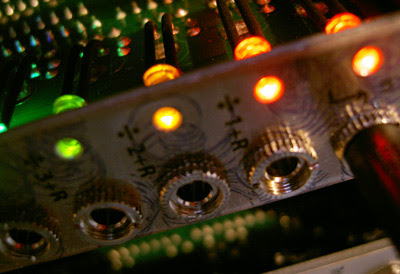
If you didn't spot Brains lurking under my DIY desktop rack in Monday's post, here's another glimpse:


Brains provides sequencing power to Make Noise's Pressure Points, offering some of the functionality of the classic Serge TKB. For a full description, see the product page and make sure you read the manual! I'd never have thought that such a small and seemingly simple clocker could open up so many possibilities. Nice work work, Tony - Brains, Pressure Points & Maths make a cracking team!

Here's a quick example using the stepped out of a Wogglebug to change the direction of a four-note (i.e. one row) sequence. When the random voltage is above 1V, the sequence runs forward. When it's below, it runs backwards. At about 23 seconds, the /6 output of a 4ms RCD steps a sequential switch to add rows 2 & 3 to the chain, creating a 12-note sequence.


Bugbrains

Brains comes with all the necessary cables to connect the unit to two Pressure Points as well as chain the touchplates and is available now from Schneidersbuero. I'll be taking a closer look at the possibilities offered by Brains later in the week. In the meantime, if you have Pressure Points, do yourself a favour and get this module. It's … a no-brainer.

Monday, 8 March 2010

Hands On Experience Part II

A collection of recordings and patch ideas, focussing on manual manipulation and featuring Flight of Harmony's Choices joystick and Make Noise's Pressure Points touch keyboard.


In this first Pressure Points patch, I fed the X & Y rows to an A-151 sequential switch and the bussed gate to a clock divider to generate an eight note sequence. The bussed press CV was used to provide volume control. This is a simple patch to overcome the limitations of only having one PP and also provides variation on an otherwise predictable sequence of notes, depending on the division you use to trigger the multiplexer.


eightpointplan

Variation on the above. Press CV used to provide mild pitch bend of a self-oscillating filter and modulate the frequency of an LFO .


whistler

In this patch I sent the press CV to a quantizer via a slew limiter to generate a glissando effect in addition to the main pitch CV. I used row X to set different slew rates, the effect of which you can hear towards the end of the recording.


gliss

One odd thing about capacitance is the fact that it is always changing. Have a listen to what happens when I touch the metal frame of my Doepfer case:


rackbuzz

Make Noises' Pressure Points brings the capacitive keyboard, best known from Buchla and Serge systems, to the Euro format. This sort of controller might not be as immediate as a joystick but it offers a wealth of subtle possibilities. PP is tweakable and, given the right settings and playing style, responsive. For best results with the press CV, a slew limiter like Maths is a must as is an exponential VCA for dynamic volume contours. It is possible to confuse the circuit with rapid finger movements or multiple presses but, as Tony Rolando points out, this is the nature of the beast. It'll be interesting to see what the promised Points Expander brings to the party.

To round things off, here is a last patch featuring both controllers:


idlehands

PP transposes the sequence and generates volume levels (both signals slewed by Maths). Choices provides panning control and cross-fades between the sine and PWM (row Y sets rate) outputs of a Plan B Model 15 VCO which is filtered by a M13 LPG. The manual gate is used to open a VCA containing the output of PP's row Z, which is used to change the speed of the clocking LFO.

For more programmer patch tips, run a search for the Rich Gold Serge book and Buchla Music Easel manual.

Saturday, 20 February 2010

Under Pressure


Introducing Hubert, a DIY pressure controller.

I got to play with the prototype last week and had a lot of fun. Here's a brief description of this hand-held device from Zauner Elektronik:

"Each channel has three outputs: CV Out, Inverted CV Out and Gate out. Each side is capable of holding the current voltage on CV Out, whereas the inverted CV appears on Inverted CV Out. If a CV is held in the CV Out you still can use the inverted out, even switching from positive to negative voltage as often as you want without disturbing the held CV output."

The hold function exhibits minimal droop and is key to working with Hubert: you can set a voltage with the pressure pads, sample it and then use the second output to generate another voltage on the same channel. This gives you a total of two dynamic and two static CVs.

I'm looking forward to getting my hands on Make Noise's Pressure Points but, having seen Katavist's wonderful BugBrand CTL-1/ Wiard JAG demo, I'm beginning to wonder whether it offers the full monty viz. its current lack of sequencing options.

Also, despite the allusion in the name of the Make Noise module and the controller description at the BugBrand site, neither of these interfaces actually respond to pressure. This might be semantic hair-splitting on my part but, as you can see from the Hubert demo video, there really is a different feel to playing a device with genuine pressure sensors.

Zauner are currently working on a second revision which will include two independent manual gate buttons and threshold level pots for the pressure-activated gates.

Sunday, 22 August 2010

Patch Tips #12 - More Mixed Envelopes

Mixing envelopes for tailor-made transients. A follow-up this post.


Today's Patch Tip aims to overcome the limitations of the simple ADSR envelope when used to open a filter or VCA. I often find that in addition to controlling the time it takes for an envelope to reach it's peak value, I also want to control the level of that stage. This is especially true of the attack portion when I want more 'bite' without increasing the overall modulation depth of the D, S & R stages. Mixing an ADSR with an AD envelope solves this problem:

envmix1.mp3

Cwejman VCO-2RM (+ sub ex A-160) > Borg filter, ADSR-VC2 + Bananalogue VCS > Fonitronik polarizing mixer > Borg. Gate to both envelopes. Pitch CV > VCOs + Borg 'key in'. Makenoise Pressure Points row 1 offsets pitch of oscillator 2, row 2 > VCS VC rise.

This is a simple but effective solution without getting into the complexities of patching-up a time/ level envelope as found on the Korg Poly 800 or Roland JD-800. If you did, however, want to try this, the Maths, Brains/ Pressure Points and Doepfer A-143-1 manuals all offer examples.

Friday, 19 March 2010

Patch Tip #4 - Gate to Trigger Converter


Using Maths to convert a gate to trigger to ping a filter.

To get really percussive sounds when pinging a filter you need an extremely short impulse. Envelopes are either too long or generate a decay phase which can lead to a misfiring of the filter.

To get clean, short spikes feed your gate signal to Maths' channel one, set R&F to zero and patch the EOR out to your filter's audio input. You can vary the trigger length by altering the fall time or, for more subtle changes, the response curve from log to exp.


In the example I've used the Pressure Points to generate the gate signal which is fed to Maths for conversion, row one to provide a pitch CV and row two to set the dual peak spacing on a Cwejman MMF-1.

Sunday, 9 May 2010

4MS RCD update & SCM preview

An overview of the updated 4MS Rotating Clock Divider and a taste of the company's next product, the Shuffling Clock Multiplier.


I liked the RCD when I first tried it, but missed the ability to output gates and, more importantly, wished it could count on the downbeat. This latest update delivers both features and makes the Rotating Clock Divider perfect.

Here are some short examples:


Downbeat counting. /1, /2 & /4 outputs drive three envelopes, Pressure Points rotates.


Similar to the above, but with gates rather than triggers.


This third recording demonstrates an interesting side effect of the way the RCD generates its gates in upbeat mode: the /1, or mult of the source clock, is inverted, resulting in a funky offbeat. The first half of the clip is upbeat the way we know and love it from the A-160 (source plus /4), the second half is the RCD. If you want a 'normal' upbeat division to play against your source, take the mult directly from your clock rather than the RCD.


Upbeat + Gate. A-160 then RCD.

I've been very lucky to have had the beta versions of the Shuffling Clock Multiplier and SCM Breakout for testing. In the past week, I've had so much fun twisting rhythms that I'm sad to have to send them back. The final feature-set and layout will likely change, so I won't go into any great detail. Suffice it to say, that rotating, shuffled clock multiplications are an even bigger hoot than divisions.

The SCM takes an incoming clock and multiplies it. These multiplications are available at separate outputs and, like the RCD, these can be rotated. The x4, x6 & x8 clocks have twin outputs, and these can be played off against each other for swing and drop-out effects. Lastly, you can also modulate the pulse width of the resulting gates.

Here are some examples of the key functions:


Left = x4, right = S(x4). Slippage altered first, then shuffle, then both. These functions are related: one determines the amount of swing, the other which beats are swung.


Same as above. Skip selects which beats are 'dropped'.

For more details on the SCM see the 4MS website and Youtube demos.

The breakout module is key as it gives you manual and CV access to these functions and, as you can tell from this final recording, makes the SCM a very playable instrument:

4ms SCM jam by navs

Two VCOs, SCM, quantizer, analogue shift register and a couple envelopes and VCAs. Sequence sent to VCO1 (left) and multed to the ASR which is clocked by the S(x4) output. The shifted clock and pitch information is sent to VCO2 (right). Manual tweaks of the clock, SCM, ASR output and quantizer scale.

Thanks to Dann of 4MS for the updated RCD - I can't wait to get my hands on the final SCM!

Wednesday, 10 March 2010

PotD - Patch Collective

Live performance patch featuring 4 VCOs, 2 LPGs, 4 EGs, quantizer, analogue shift register, mux, Choices, Pressure Points, a bunch of mixers & VCAs and a pair of hands.

PotD_Patchcollective  by  navs

As you can tell from the long list of modules, this patch took some setting up, but was quite simple once I knew what I wanted. The combination of PP & Choices offered a variety of control options and made this patch come to life.

You can probably guess most of what's happening in the recording, so I won't go into detail. One tip I'd like to share with you, though, is how I controlled the Low Pass Gates as this was key to the patch. I mixed Choices Y output with the envelopes to open the LPGs for the sustained sounds and then close them for the short note runs. Really simple, but effective.

And if you're wondering how I achieved the slow, rising pitch in the sustained passages, that's the sound of a voltage-loaded but un-triggered Plan B M23 ASR!

Thursday, 4 March 2010

Toppobrillo TWF Update


Some more examples of the wonderful Toppobrillo Triple Wave Folder.


Self-running patch comprising two VCOs & VCAs, Maths & Wogglebug. One VCO is folded, the other modulates the TWF's Bias, WB is triggered by Maths' EOR, stepped out to pitch, envelope slopes and WB clock.

Recorded in response to Rechner7's Stockhausen-esque Noise Ring/ Pressure Points patch.

Wavefolders respond to dynamic changes, so I gated both the carrier and modulator before sending them to the TWF. This can have a dramatic effect and this patch would not have sounded the same had I gated the output post folding.

This is an example of using the TWF to achieve linear-FM-like sounds: tbtwf_doublebass

Again, the VCO was first sent to a VCA. An envelope modules the bias, manual tweaks to envelope times and DC offset. Pure sine first, then folded.

This sort of sound is normally quite tricky to achieve via analogue FM, because of phase and tracking issues.

Here's an evolving sound featuring a sine wave some light envelope modulation of bias and manual tweaks: tbtwf_evolve

The Triple Wave Folder has so many sweet-spots for this kind of tonal shaping and the output is clean enough so you don't need further filtering.

Lastly, here's an example of the TWF's saw to sine function: tbtwf_saw2sine and a PDF with software 'scope pictures.

As you can hear, it does a great job. I asked Josh about the rounding of the saw evident in the 'scope shot and he confirmed that this is normal. He also explained how he achieved the panning effect in his demo: the resulting sine is 90 degrees out of phase so all you need is a multi-output LFO/ oscillator. Thanks Josh!

Saturday, 24 November 2012

Fonitronik mh11 ADC Pattern Sequencer

Hands-on preview of Fonitronik's novel 8-step CV & Gate sequencer.


The mh11 offers a new take on the basic sequencer concept. An analogue to digital converter generates 256 patterns. The notes and direction stay the same, but the sequence of steps that actually get played is under manual or voltage control.

For more on the concept, see Matthias' own description and video. Here's a demo of the effect of CV-ing the pattern on notes played & (0:34) gate length and (0:57) the mh11 as graphic VCO.


(edit: Bandcamp's MP3 conversion has mangled the graphic VCO example. Download the WAV.)

To understand what's happening, feed the mh11 a clock and set all step switches to the up/ on position. All steps play. Then 'mute' certain steps by setting the switch to the off position. The ADC is used to automate this muting - it generates an 8-bit string of on & off values which is AND gated with the incoming clock. To test this, stop the sequencer, set all switches down to the ADC position and turn the manual PCV pot until all lights of the pattern LED-bar are lit. Restart the sequencer and turn the pattern knob. Any incoming CV is summed with the manual offset to generate a new string of on & off values.

Programming the mh11 is easiest with another sequencer or S&H (running at a clock division) or a S&H-synchronized manual CV from Pressure Points. This is because the ADC 're-computes' the pattern with every change. You can use an LFO, but depending on the speed, things can get glitchy. At audio-rates, as per the graphic VCO example, this is not a problem. The 4MS PEG makes a good partner for the mh11 as its swings can be synced.

In use, I found a few minor issues: if fed more than 8V, the ADC can lock up. Remove the external CV and twist the offset pot to reset it. I felt this offset should be inverted so that one can start with all steps on and then progressively mute them with a +ve CV. The output CV droops slightly when passively multed, so you may want to buffer it. Finally, the ADC controls both the CV and gate signals. Muting a trigger or tying a gate also mutes the CV. So, you can't send the CV to two VCOs and have one follow the pattern and the other the master clock. I asked Matthias whether this could be changed, but quickly realized it would require a second, parallel ADC.

The build quality is solid, the layout generous and the LEDs give good visual feedback of the ADC's current pattern. A microprocessor-based sequencer might offer more options, but I do get a kick out of imaginative designs like the mh11. Thanks to Matthias for the loan of the module and for keeping it analogue!

Friday, 2 July 2010

Cwejman RES-4 Demo

Recordings of the quintessential Cwejman module, the Quad VC Resonator.


Download the album for €1 or more to access the audio examples.

For an overview of what the module does, read this Sound On Sound review and for some practical tips on how you might use the RES-4, read this chapter of the classic Synth Secrets series. If the formant techniques described by Gordon Reid sound too much like hard work, you could, of course, just patch a sawtooth into the RES-4, twist the knobs and see what happens.

Listen to the 'Oriental' and 'Formant' examples. The recordings not only show off the sort of vocal effects the RES-4 is capable of, but also the stereo spread caused by the phase cancellations and additions of the four filters when mixing the BP and Notch outputs. 'Voice' and 'Breathing' are similar, using higher Q settings for some resonant phasing. As you can hear, the RES-4 can be used for frequency-dependent panning.

Unlike the MMF-1, the RES-4 needs an input to start oscillating or ringing. A little white noise or short trigger impulse from Maths' EOR does the trick nicely. Listen to the 'Ping' and 'Shiftregister' examples. For me, this is the quad resonator's trademark sound. I know it drives some people nuts, but I love it. Higher Q settings will yield longer rings, using Pressure Points or an analogue shift register allows you to play four-note chords or complex cascades.

Feeding the result into a wavefolder can add bite or bring out steel string-like qualities. Tuning the resonant frequencies and adjusting the gain levels gets you into physical modeling territory. Listen to the 'TWFolded' and 'Logdrums' examples.

'Spacejam' show-cases some of all of the above. It's a single pass, live recording featuring just one VCO, the RES-4 and maybe a touch too much EHX SMMH delay. When the oscillator is slow and the Q high enough, the filter is pinged. At audio rates, the effect is similar to the first couple of recordings.

One last feature that should be mentioned is the amount of voltage control this module offers: frequency and volume on master or individual level, bandwidth per filter. As stretta expertly shows, this allows dynamic and precise settings, although so far, I've been happy enough making manual changes.

I ignored the RES-4 for many years, in part due to its price, but in the time that I've had it has become a firm favourite. The build quality is top notch and the sonic results unique. For more RES-4 examples, listen to the 'dampf', 'nutong' & 'eszieht' tracks from my Synthetic Nature EP or run this search.

Monday, 26 July 2010

Release: Best of Patch of the Day

I've just released The Best of Patch of the Day Vol. 1, which is available from my bandcamp page for three Euros.

<a href="http://navs.bandcamp.com/album/best-of-patch-of-the-day-vol-1">prebloom by Navs</a>

The EP contains some patches from the past plus one new recording. Prebloom is a live performance featuring a Cwejman RES-4 & CTG-VC, Toppobrillo TWF, Doepfer A-143-1, Plan B Model 15 & Harvestman Hertz Donut VCOs, Makenoise Pressure Points and f(h) Choices joystick. I'll leave you to figure out the patch configuration from my previous examples!

Tuesday, 13 April 2010

4MS Rotating Clock Divider


First impressions of the 4MS Rotating Clock Divider.

This colourful module is an update on the classic clock divider design, offering even and un-even divisions of 1 to 64 and a unique rotate function to shift the resulting triggers along its eight outputs.

Here's a run-through featuring four voices. Towards the end, a random CV is applied to the rotate function.


The next example focusses on the rotate function, which is addressed via a CV. While this is more complicated than stepping with a gate, it allows programmed timing-changes with a sequencer or preset controller like Pressure Points.


The RCD outputs triggers, rather than gates. This is useful for percussive material, but has implications for certain logic gating functions. In this example, the main clock is AND-gated by the /4 output, first with a Doepfer A-160, then with the RCD.


The RCD will also function as an audio sub-divider. Here too, the results are different to the A-160 because of the lack of gates.


Sine wave source mixed with 'divided' signal. Choices joystick used to first rotate and then also change pitch.

The following example uses the RCD as a simple three-voice sequencer. The clock is reset on the first beat of the bar until the 1:25 mark (shortly after the FM index riser). Thereafter, the divisions are allowed to run free until about 1:50 (after the decay of the open high hat is lengthened) when it is snapped back into sync. A joystick was used to provide the rotate CV.


This was a lot of fun, but it did highlight an issue common to both the RCD and A-160: neither play 'on the one'. This is apparent when the drums are faded in (0:30). The cymbal denotes the down-beat, the RCD is playing off-beat. This can be 'corrected' on the A-160 with a logic inverter but, as the RCD outputs triggers, this is not possible. Another thing that became clear was the need for some planning with a programmer to set appropriate divisions, rather than wiggling a joystick!

The RCD got me thinking and working in a way I hadn't previously and I wanted to see whether the A-160/ 1 could compete. In this recording I mimicked the previous patch with the Doepfer clocking modules and fed four different reset triggers via an A-151 sequential switch which I stepped with a manual gate.


This resulted in less drastic changes than rotating divisions, but the shifting rhythmical patterns were no less musical or interesting. I also got the impression that the Doepfer divider had a bit more 'funk' than the 4MS, but this might just be down to timing inaccuracies on the part of the A-160.

The 4MS Rotating Clock Divider is mesmerizing, immediate and a lot of fun. Having easy access to un-even divisions was a revelation and the reset possibilities allow for complex rhythmic patterns. I'm not sure I'd want it as the only clock divider in my system, but it could certainly fulfill that role.

To wrap things up, today's Patch of the Day features the RCD and Plan B's M23 ASR.


shufti

Two VCOs, panned left and right receive shifted pitch and trigger information. A Wogglebug provides a random CV to rotate the RCD, modulate Maths' envelope length and transpose the sequence.

Monday, 8 March 2010

Hands On Experience Part I

A collection of recordings and patch ideas, focussing on manual manipulation and featuring Flight of Harmony's Choices joystick and Make Noise's Pressure Points touch keyboard.


First up, Choices is used to modulate the FM relationship of two VCOs and the time-base, or overall length, of a Plan B Polyphonic Envelope. Choices' manual gate was patched to the M10's cycle input to provide the trills.


trillkillkult

In this patch, Choices was used to manually trigger the envelope. Depending on the modulated envelope length, this sometimes results in trills. The joystick was used to modulate the pitch of the VCOs and provide the CV for an A-134-2 cross-fader.


crossover

A similar patch, minus the cross-fader, of 'chirps and cheeps' generated by a self-oscillating filter, FM'd by the modulated envelope.


bugsnbirds

Using a joystick is very intuitive and a lot of fun: move it, and you have a pretty good idea of what's going to happen. I considered getting Doepfer's A-174 because I like sprung joysticks. As it was out of stock and a new shipment of Choices had just arrived, I bought the f(h) module and have no regrets: unsprung joysticks have their own benefits and the manual gates are very useful. Choices has a hotter output than the A-174 and offers more control over in & ouputs. Match this up with an integrator, quantizer, cross-fader and a re-triggerable AD envelope for a dynamic performance tool.

Friday, 15 October 2010

Schneiders London Testsalon Opening

Some pictures from the opening event at Rough Trade East last Sunday.


It's been a while since I've been down Brick Lane and I was amazed at the buzz on the streets. Rough Trade East is a great location for the Testsalon and I wish Andreas and the lads every success with the venture. Thanks to everyone who came along - it was great to meet you!


TOP: Cwejman RES-4, MMF-1, Toppobrillo TWF, A-132 VCA, Harvestman Hertz Donut, VCA-4MX; BOTTOM: A-147 VCLFO, A-160/1 clock divider/ sequencer, Fonitronik Attenuverting Mixer, Analogue Solutions SH-NZ, Make Noise Wogglebug & Maths, Bananalogue/ Serge VCS.

Above is a picture of the 6U case I took with me. I can happily confirm that it met Easyjet's carry-on luggage regulations. There was a sharp intake of breath from the passengers behind me as I opened the case at security in Berlin - the people at Luton didn't even bat an eyelid. I asked Easyjet about taking a 9U as carry-on: unfortunately, it's too big.

Putting together a 6U performance case was a real challenge. My normal approach is to ensure that I have all eventualities covered e.g. VCAs, polarizers, mixers etc., but this time the solution was to think in terms of the set I wanted to play and populate the case accordingly. Anything I hadn't used in rehearsal (mults, logic, sound-shaping filters, complex envelopes etc.) was easily left out.

My set comprised of three sections and relied on re-patching & repurposing the modules e.g. filter as oscillator, envelope as trigger delay etc. Rather than using LFOs, a joystick or keyboard/ Pressure Points, I made all changes manually.

Section one: white noise tuned by the RES-4 to provide a pad, the MMF-1 randomly pinged by the Wogglebug (the Allen Strange 'tail-chasing' patch); section two: my faux binary zone patch (MMF-1 through TWF as bassline), RES-4 pinged by clock divider for 'Berlin-style' stabs, high-pitched waveform discontinuity sound from Hertz Donut principal as high hat, modulator as kick drum and, section three, the RES-4 excited by the VCS and run through the TWF for some distorted klonks, with the HD providing some 'stupid' accompaniment and the MMF-1 rumbling the subs.

Part workshop, part gig, this was an interesting experience - despite rehearsing, the one thing I wasn't prepared for was shaky patch-hands. On more than one occasion, I missed the jack and hit the face-plate! Self-contained instruments like Maths, the Wogglebug & Hertz Donut are perfect for small systems (although the latter's secondary CV inputs, which need to be activated, are hardly performance-friendly!). The biggest lesson, though, was to bring your own monitoring: if you can't hear your music properly, you can't respond. Next time, I'll be wearing headphones!

Monday, 26 July 2010

A Simple Case of Brawn over Brains

Got a spare 3U rack that you'd like to use on your desktop to house performance modules like Pressure Points and Choices?

Unscrew these:


Take them to your local Schlosser and get him to fashion them like this with his Schlagschere:


Screw them back in place and enjoy!


Thanks to Max Kruppa in Kreuzberg for their time and effort.

Monday, 5 April 2010

Patch Tip #7 - Synced Transposition


Today's tip is adapted from Rob Hordijk's excellent Nord Modular tutorials.

Here's the situation: you have a clocked sequence that you want to manually transpose with Pressure Points. Try as you might, your timing isn't precise enough to avoid pitch glitches:


In the above, PP's row 1 CV was patched directly to the transpose input of an A-156 QNT. Taking the CV and first patching it to a sample & hold, which is triggered by a clock division, synchronizes the manual changes:


Hordijk's patch is a little more involved, but in the second example I simply used an inverted output of the A-160 to trigger the S&H. Another option would be to use the 'step1' output of an Analogue Solutions SQ8.

Tuesday, 7 September 2010

Patch of the Day - Lagtyme

Featuring the Toppobrillo Sport Modulator as VC divider and Triple Wave Folder as VC Multiplier.

<a href="http://navs.bandcamp.com/track/lagtyme">lagtyme by Navs</a>

Today's PotD is based on the 'VC divider' patch with the added twist of a multiplied pulse train courtesy of the TWF. Mult your clock source to four destinations: the TWF, Env1, SM1 S/H and SM2 S/H. Set both sections of the SM to cycle in 'hold' mode, send the output to two VCOs (in this case for pitch and PWM) and the End Out to envelopes 2 & 3. Take the TWF's pulse output to trigger a fourth envelope. In the recording, the first sound you hear is paced by the source clock, the two VCOs by the divisions generated by the SM and the hi-hat by the TWF stream.

You might not want the pitch changes generated by patching the SM's outs to the VCOs, but in this case it allowed me to generate some noise bursts by flicking each section's mode button from S&H to lag and hold. I also added some variation to the patch by sending three CV variables from Pressure Points to the two Toppobrillo modules.

For more patch ideas, see the Sport Modulator page and manual here.

Monday, 9 April 2012

Patch Tips #23 - PEG Burst Generator

How to patch the 4ms PEG for use as a synced burst generator.


I love the burst output of the Wogglebug but sometimes want the pulse streams to be in time and on command. The PEG makes this easy:


Patch your master clock to the Ping input on one PEG channel. Send your gate - or 'on' command - to the QNT input. I used the T-Gate output of Pressure Points in the example.

Using the QNT input means the PEG will only fire when told to, thus avoiding the need for extra AND logic. It also means it will repeat/ loop its envelopes at a rate set by the div/ mult.

Keep the curve linear and set the skew clockwise for an instantaneous attack time. The EOR now becomes your timing pulse, which you can use to trigger another envelope.

With the basic patch set, use the EOF to trigger a random generator like the Wogglebug. Patch its stepped output to the PEG's div/mult CV to get random but in sync bursts.

If you have an SCM and Expander, you can try a similar patch using the mute and rotate inputs.

Friday, 30 July 2010

PotD - Brains Releasequence


Today's Patch of the Day showcases some of the features that make the combination of Brains, Pressure Points and Maths such a flexible & tactile sequencing package.


Here are the patch details:

Cycling Maths Ch1 acts as clock. EOR > Brains CLK.
Linear, R = 0, Fall = 14:30
Envelope controls VCA depth + VCO FM Index.

Maths Ch4 slews Press CV from PP buss (use input, not trigger).
R + F ca. 15:00, exponential.
Slewed CV > VCA (dynamics), Brains 'Run' + Maths Ch2.
Set Ch2 to ca. 22:00 (-ve) and patch to Ch1 Fall VC

Patch PP rows 1-3 > sequential switch. PP row 1 gate > A-152 clock.
Digital out 4 > reset, common I/O > quantiser > VCO.

And here's what's happening:

Although Maths is cycling and providing Brains with a clock, the sequence is blocked from running until the press CV exceeds 1V. On release of the touch plate, the Press CV fades out, allowing the sequence to continue running until it again falls below 1V. An inverted mult of the press CV, which is fed to Ch1's Fall VC via Ch2, controls the speed of the clock. The harder you press, the faster the clock. As the press CV fades, the clock slows. Try different rise and fall times for both channels 1 + 4 and the amount of fall VC from Ch2 to taste. You could, for example, have the sequence get faster as the volume fades. The remaining connections (Ch4 EOC > Brains reset, PP rows 1-3 > multiplexer etc.) are non-essential, but nice.