Showing posts sorted by relevance for query rcd. Sort by date Show all posts

Tuesday, 13 April 2010

4MS Rotating Clock Divider


First impressions of the 4MS Rotating Clock Divider.

This colourful module is an update on the classic clock divider design, offering even and un-even divisions of 1 to 64 and a unique rotate function to shift the resulting triggers along its eight outputs.

Here's a run-through featuring four voices. Towards the end, a random CV is applied to the rotate function.


The next example focusses on the rotate function, which is addressed via a CV. While this is more complicated than stepping with a gate, it allows programmed timing-changes with a sequencer or preset controller like Pressure Points.


The RCD outputs triggers, rather than gates. This is useful for percussive material, but has implications for certain logic gating functions. In this example, the main clock is AND-gated by the /4 output, first with a Doepfer A-160, then with the RCD.


The RCD will also function as an audio sub-divider. Here too, the results are different to the A-160 because of the lack of gates.


Sine wave source mixed with 'divided' signal. Choices joystick used to first rotate and then also change pitch.

The following example uses the RCD as a simple three-voice sequencer. The clock is reset on the first beat of the bar until the 1:25 mark (shortly after the FM index riser). Thereafter, the divisions are allowed to run free until about 1:50 (after the decay of the open high hat is lengthened) when it is snapped back into sync. A joystick was used to provide the rotate CV.


This was a lot of fun, but it did highlight an issue common to both the RCD and A-160: neither play 'on the one'. This is apparent when the drums are faded in (0:30). The cymbal denotes the down-beat, the RCD is playing off-beat. This can be 'corrected' on the A-160 with a logic inverter but, as the RCD outputs triggers, this is not possible. Another thing that became clear was the need for some planning with a programmer to set appropriate divisions, rather than wiggling a joystick!

The RCD got me thinking and working in a way I hadn't previously and I wanted to see whether the A-160/ 1 could compete. In this recording I mimicked the previous patch with the Doepfer clocking modules and fed four different reset triggers via an A-151 sequential switch which I stepped with a manual gate.


This resulted in less drastic changes than rotating divisions, but the shifting rhythmical patterns were no less musical or interesting. I also got the impression that the Doepfer divider had a bit more 'funk' than the 4MS, but this might just be down to timing inaccuracies on the part of the A-160.

The 4MS Rotating Clock Divider is mesmerizing, immediate and a lot of fun. Having easy access to un-even divisions was a revelation and the reset possibilities allow for complex rhythmic patterns. I'm not sure I'd want it as the only clock divider in my system, but it could certainly fulfill that role.

To wrap things up, today's Patch of the Day features the RCD and Plan B's M23 ASR.


shufti

Two VCOs, panned left and right receive shifted pitch and trigger information. A Wogglebug provides a random CV to rotate the RCD, modulate Maths' envelope length and transpose the sequence.

Sunday, 9 May 2010

4MS RCD update & SCM preview

An overview of the updated 4MS Rotating Clock Divider and a taste of the company's next product, the Shuffling Clock Multiplier.


I liked the RCD when I first tried it, but missed the ability to output gates and, more importantly, wished it could count on the downbeat. This latest update delivers both features and makes the Rotating Clock Divider perfect.

Here are some short examples:


Downbeat counting. /1, /2 & /4 outputs drive three envelopes, Pressure Points rotates.


Similar to the above, but with gates rather than triggers.


This third recording demonstrates an interesting side effect of the way the RCD generates its gates in upbeat mode: the /1, or mult of the source clock, is inverted, resulting in a funky offbeat. The first half of the clip is upbeat the way we know and love it from the A-160 (source plus /4), the second half is the RCD. If you want a 'normal' upbeat division to play against your source, take the mult directly from your clock rather than the RCD.


Upbeat + Gate. A-160 then RCD.

I've been very lucky to have had the beta versions of the Shuffling Clock Multiplier and SCM Breakout for testing. In the past week, I've had so much fun twisting rhythms that I'm sad to have to send them back. The final feature-set and layout will likely change, so I won't go into any great detail. Suffice it to say, that rotating, shuffled clock multiplications are an even bigger hoot than divisions.

The SCM takes an incoming clock and multiplies it. These multiplications are available at separate outputs and, like the RCD, these can be rotated. The x4, x6 & x8 clocks have twin outputs, and these can be played off against each other for swing and drop-out effects. Lastly, you can also modulate the pulse width of the resulting gates.

Here are some examples of the key functions:


Left = x4, right = S(x4). Slippage altered first, then shuffle, then both. These functions are related: one determines the amount of swing, the other which beats are swung.


Same as above. Skip selects which beats are 'dropped'.

For more details on the SCM see the 4MS website and Youtube demos.

The breakout module is key as it gives you manual and CV access to these functions and, as you can tell from this final recording, makes the SCM a very playable instrument:

4ms SCM jam by navs

Two VCOs, SCM, quantizer, analogue shift register and a couple envelopes and VCAs. Sequence sent to VCO1 (left) and multed to the ASR which is clocked by the S(x4) output. The shifted clock and pitch information is sent to VCO2 (right). Manual tweaks of the clock, SCM, ASR output and quantizer scale.

Thanks to Dann of 4MS for the updated RCD - I can't wait to get my hands on the final SCM!

Thursday, 23 December 2010

DIY RCD Breakout Panel

If you haven't already done so, this is an easy build which I can highly recommend. It opens up new possibilities by bringing some of the 4MS RCD's 'hidden' features to the fore.


My original aim was simply to get front-panel access to the up/ down count and gate/ trigger switches, which normally involves unscrewing the module from the rack. I wasn't even going to connect the reset jumpers but I'm glad I did - this has a marked effect, particularly on the odd divisions. Flicking between trigger and gate mode also yields an added bonus when driving logic operations. For example, patch the /8 to Brains' 'direction' input and toggle between gate and trigger to 'activate' and 'hide' the boolean function. In combination with the reset options, this can yield some funky sequences.

The build instructions are here. Soldering took all of 20 minutes, drilling and filing the faceplate, despite the Make Noise blank being softer than metal, took two hours. Always my favourite part of DIY...

Friday, 15 April 2011

Release: Trans Europa Exzess

Studio version of my set at the Schneidersbuero Superbooth event at the Saasfee Pavillion last week.


I took a 6U system to Frankfurt, which was the same rig I used for the above recording: 4MS RCD + breakout, Analogue Solutions MX224 & SH-NZ, Cwejman RES-4, MMF-1 & VCA-4MX, Doepfer A-133, Makenoise Wogglebug & Maths, Plan B M15 & M12, Toppobrillo Sport Modulator & Triple Wavefolder and, of course, the EHX Stereo Memory Man w/ Hazarai.


This was the first time I received the full security check the airport, involving a visit to a special room and swab test on the case. A tip for modular travelers: when asked whether you are a DJ and your equipment is a mixer, answer 'yes' to both questions.

Thanks to Andreas and all involved - it was a great evening!

Saturday, 24 July 2010

4ms Shuffling Clock Multiplier & Expander


Some patch ideas featuring the 4ms Shuffling Clock Multiplier and Breakout box.

For an overview of the concept and functions of the SCM, see this post.

This first example makes use of the SCM's tap function. Given two gates, it will 'remember' the tempo until it receives new marching orders. The most obvious clock source is an LFO, but this feature means you could also feed it with a gate signal from your keyboard:


fingered

2 VCOs, left gated by keyboard, right by manually-clocked SCM. The shorter the intervals between played notes, the faster the trills.

Here's a variation on the above using a tail-chasing Wogglebug to generate gate and pitch information. I used the x1 output of the SCM to trigger Maths and fed its envelope to the level VC of a Cwejman CTG-VC to fade out the echos. This works better in the slower sections i.e. the beginning of the clip. An option would have been to VC Maths' fall time with the pitch CV e.g. higher notes = faster echos = faster fade. If you don't have a Cwejman envelope, you could use a second VCA to add similar dynamic control of your your envelope.


echo

Because the SCM 'reads' the interval between two pulses, large timing changes from fast to slow will display an amount of lag as the SCM catches up with the new tempo. This is possibly the only failing of the module but, given the difficulties in implementing clock multiplication (the SCM can't 'predict' the new tempo before it has happened!), two taps are more than acceptable and this lag can also have its musical uses as a 'ghost' beat.


lag
LFO as clock, speed manually changed.

The most obvious use for the SCM is as a drum trigger/ sequencer driver, but this last recording is an example of the SCM in an auxiliary role, helping to time the changes of a quantizer to generate sync'd glissando.


gliss
Main VCO left, clock reference right. At six seconds a slewed sequence is patched to the VCO. At about 18 seconds the sequence is re-patched to an A-156 quantizer. The quantizer responds to changes in voltage, so the steps are not in sync with the main clock. Patching an output from the SCM to the A-156's trigger input (27 seconds) resolves this and, with some rotation and slip, allows for swung or odd time glissando.

The SCM and breakout box have undergone some changes since I tested the prototype. The main differences are the addition of a x1 output, or mult of the clock source, and the loss of some of the 'straight' gate streams. I found the former to be useful on the RCD and, because the SCM generates pulses even without an input, it can function as a main clock source in a patch. The lack of some of the 'un-swung' outputs means you'll have to rotate the SCM if you want to make use of the phasing effects I demonstrated in my original post. The Breakout box has also undergone some changes, now offering a global x4 multiplier and mute function. As I previously noted, if you have an SCM, you really need the expander. Not only does it offer access to the swing & skip parameters, but it brings the SCM to life as a playable instrument. The breakout box should be available soon, so plan for one in your rack!

Wednesday, 7 July 2010

DIY Quad Slew

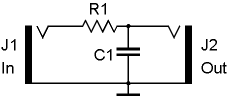
Got a spare A-180 multiple and need a simple slew to round off jaggy gates and S&H signals? Then get out your soldering iron and follow this simple schematic from the Doepfer DIY page.


As you can hear, it's great for removing the clicks you get when feeding a VCA with abruptly changing signals:


(before and after)


Filters also benefit from 'softer' control. I built this as a companion to my Plan B M23 ASR, but you could also feed the quad slew with the outputs of a clock divider like the 4ms RCD and take these outputs directly to your VCA. A cheap and small alternative to tying-up four envelopes!

I used a 4k7 resistor and 1uF capacitor, but you could try other values for a more or less rounded result.

Thanks to fonitronik for the suggested values and help!

Wednesday, 28 July 2010

Make Noise Brains

If you didn't spot Brains lurking under my DIY desktop rack in Monday's post, here's another glimpse:


Brains provides sequencing power to Make Noise's Pressure Points, offering some of the functionality of the classic Serge TKB. For a full description, see the product page and make sure you read the manual! I'd never have thought that such a small and seemingly simple clocker could open up so many possibilities. Nice work work, Tony - Brains, Pressure Points & Maths make a cracking team!

Here's a quick example using the stepped out of a Wogglebug to change the direction of a four-note (i.e. one row) sequence. When the random voltage is above 1V, the sequence runs forward. When it's below, it runs backwards. At about 23 seconds, the /6 output of a 4ms RCD steps a sequential switch to add rows 2 & 3 to the chain, creating a 12-note sequence.


Bugbrains

Brains comes with all the necessary cables to connect the unit to two Pressure Points as well as chain the touchplates and is available now from Schneidersbuero. I'll be taking a closer look at the possibilities offered by Brains later in the week. In the meantime, if you have Pressure Points, do yourself a favour and get this module. It's … a no-brainer.