Showing posts sorted by relevance for query asr. Sort by date Show all posts

Sunday, 9 May 2010

4MS RCD update & SCM preview

An overview of the updated 4MS Rotating Clock Divider and a taste of the company's next product, the Shuffling Clock Multiplier.


I liked the RCD when I first tried it, but missed the ability to output gates and, more importantly, wished it could count on the downbeat. This latest update delivers both features and makes the Rotating Clock Divider perfect.

Here are some short examples:


Downbeat counting. /1, /2 & /4 outputs drive three envelopes, Pressure Points rotates.


Similar to the above, but with gates rather than triggers.


This third recording demonstrates an interesting side effect of the way the RCD generates its gates in upbeat mode: the /1, or mult of the source clock, is inverted, resulting in a funky offbeat. The first half of the clip is upbeat the way we know and love it from the A-160 (source plus /4), the second half is the RCD. If you want a 'normal' upbeat division to play against your source, take the mult directly from your clock rather than the RCD.


Upbeat + Gate. A-160 then RCD.

I've been very lucky to have had the beta versions of the Shuffling Clock Multiplier and SCM Breakout for testing. In the past week, I've had so much fun twisting rhythms that I'm sad to have to send them back. The final feature-set and layout will likely change, so I won't go into any great detail. Suffice it to say, that rotating, shuffled clock multiplications are an even bigger hoot than divisions.

The SCM takes an incoming clock and multiplies it. These multiplications are available at separate outputs and, like the RCD, these can be rotated. The x4, x6 & x8 clocks have twin outputs, and these can be played off against each other for swing and drop-out effects. Lastly, you can also modulate the pulse width of the resulting gates.

Here are some examples of the key functions:


Left = x4, right = S(x4). Slippage altered first, then shuffle, then both. These functions are related: one determines the amount of swing, the other which beats are swung.


Same as above. Skip selects which beats are 'dropped'.

For more details on the SCM see the 4MS website and Youtube demos.

The breakout module is key as it gives you manual and CV access to these functions and, as you can tell from this final recording, makes the SCM a very playable instrument:

4ms SCM jam by navs

Two VCOs, SCM, quantizer, analogue shift register and a couple envelopes and VCAs. Sequence sent to VCO1 (left) and multed to the ASR which is clocked by the S(x4) output. The shifted clock and pitch information is sent to VCO2 (right). Manual tweaks of the clock, SCM, ASR output and quantizer scale.

Thanks to Dann of 4MS for the updated RCD - I can't wait to get my hands on the final SCM!

Monday, 9 November 2009

PotD - The Organ Grinder

Featuring the Plan B Model 23 Analog Shift Register.


The Organ Grinder plays his merry tune. All is well until monkey and Schnapps get the better of him:

PotD - The Organ Grinder  by  navs

In this patch the M23 was used to shift a quantized sequence to a pair of detuned VCOs, the 'both' input of a Bananalogue/ Serge VCS and the CV input of a VC-LFO. The sequence was transposed by the stepped output of a Wogglebug. A sequential switch was used to alternate between a 'regular' and voltage controlled clock. The switch was triggered by a comparator reading the output of a second random source.

--

UPDATE: Patch details

I tried to keep the patch description as simple as possible, but for those of you who want to try this here is a patch chart.

The A-147 VC-LFO acts as the master clock and feeds the SQ8, which sends a gate to the VCS (or Maths).

The envelope generated by the VCS is patched to the output VCA. In my patch I fed the two VCOs to a separate mixer (VCA-4MX) before the final VCA (VCA-2P), but for simplicity I've shown an A-131 in this chart.

The sequence generated by the SQ8 goes to an A-156 quantizer, the CV goes to the ASR and the trigger output of the A-156 clocks the ASR. From there, output one goes to VCO1, output 2 to VCO2, output 3 to the second input of an A-151 switch and the last output feeds the 'both' input of the VCS.

The random elements:

the 'step1' output of the SQ8 clocks the Wogglebug. In turn, its clock output steps the S&H/ noise.

The Wogglebug's stepped out feeds the transpose input of the quantizer. At the beginning of the patch I kept the randomness to about 9 o'clock, towards the end I swept it up manually and then back to zero.

The SH-NZ output feeds an A-119, which I've used as a comparator. Depending on the gain & threshold settings you can generate an amplitude-dependent gate. As the A-151 feeds the CV-in of the VC-LFO, the gate toggles the switch between 'regular' and VC-clock. As an alternative, you could use a VCA to alter the amount of VC-clock or, indeed, alter the CV amount manually. If you don't have a comparator or A-119, you could use the burst output of the Wogglebug. I sometimes find this too frenetic, so I send the burst gate to a clock divider to calm it down a bit!

Wednesday, 10 March 2010

PotD - Patch Collective

Live performance patch featuring 4 VCOs, 2 LPGs, 4 EGs, quantizer, analogue shift register, mux, Choices, Pressure Points, a bunch of mixers & VCAs and a pair of hands.

PotD_Patchcollective  by  navs

As you can tell from the long list of modules, this patch took some setting up, but was quite simple once I knew what I wanted. The combination of PP & Choices offered a variety of control options and made this patch come to life.

You can probably guess most of what's happening in the recording, so I won't go into detail. One tip I'd like to share with you, though, is how I controlled the Low Pass Gates as this was key to the patch. I mixed Choices Y output with the envelopes to open the LPGs for the sustained sounds and then close them for the short note runs. Really simple, but effective.

And if you're wondering how I achieved the slow, rising pitch in the sustained passages, that's the sound of a voltage-loaded but un-triggered Plan B M23 ASR!

Tuesday, 13 April 2010

4MS Rotating Clock Divider


First impressions of the 4MS Rotating Clock Divider.

This colourful module is an update on the classic clock divider design, offering even and un-even divisions of 1 to 64 and a unique rotate function to shift the resulting triggers along its eight outputs.

Here's a run-through featuring four voices. Towards the end, a random CV is applied to the rotate function.


The next example focusses on the rotate function, which is addressed via a CV. While this is more complicated than stepping with a gate, it allows programmed timing-changes with a sequencer or preset controller like Pressure Points.


The RCD outputs triggers, rather than gates. This is useful for percussive material, but has implications for certain logic gating functions. In this example, the main clock is AND-gated by the /4 output, first with a Doepfer A-160, then with the RCD.


The RCD will also function as an audio sub-divider. Here too, the results are different to the A-160 because of the lack of gates.


Sine wave source mixed with 'divided' signal. Choices joystick used to first rotate and then also change pitch.

The following example uses the RCD as a simple three-voice sequencer. The clock is reset on the first beat of the bar until the 1:25 mark (shortly after the FM index riser). Thereafter, the divisions are allowed to run free until about 1:50 (after the decay of the open high hat is lengthened) when it is snapped back into sync. A joystick was used to provide the rotate CV.


This was a lot of fun, but it did highlight an issue common to both the RCD and A-160: neither play 'on the one'. This is apparent when the drums are faded in (0:30). The cymbal denotes the down-beat, the RCD is playing off-beat. This can be 'corrected' on the A-160 with a logic inverter but, as the RCD outputs triggers, this is not possible. Another thing that became clear was the need for some planning with a programmer to set appropriate divisions, rather than wiggling a joystick!

The RCD got me thinking and working in a way I hadn't previously and I wanted to see whether the A-160/ 1 could compete. In this recording I mimicked the previous patch with the Doepfer clocking modules and fed four different reset triggers via an A-151 sequential switch which I stepped with a manual gate.


This resulted in less drastic changes than rotating divisions, but the shifting rhythmical patterns were no less musical or interesting. I also got the impression that the Doepfer divider had a bit more 'funk' than the 4MS, but this might just be down to timing inaccuracies on the part of the A-160.

The 4MS Rotating Clock Divider is mesmerizing, immediate and a lot of fun. Having easy access to un-even divisions was a revelation and the reset possibilities allow for complex rhythmic patterns. I'm not sure I'd want it as the only clock divider in my system, but it could certainly fulfill that role.

To wrap things up, today's Patch of the Day features the RCD and Plan B's M23 ASR.


shufti

Two VCOs, panned left and right receive shifted pitch and trigger information. A Wogglebug provides a random CV to rotate the RCD, modulate Maths' envelope length and transpose the sequence.

Wednesday, 7 July 2010

DIY Quad Slew

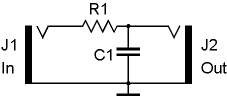
Got a spare A-180 multiple and need a simple slew to round off jaggy gates and S&H signals? Then get out your soldering iron and follow this simple schematic from the Doepfer DIY page.


As you can hear, it's great for removing the clicks you get when feeding a VCA with abruptly changing signals:


(before and after)


Filters also benefit from 'softer' control. I built this as a companion to my Plan B M23 ASR, but you could also feed the quad slew with the outputs of a clock divider like the 4ms RCD and take these outputs directly to your VCA. A cheap and small alternative to tying-up four envelopes!

I used a 4k7 resistor and 1uF capacitor, but you could try other values for a more or less rounded result.

Thanks to fonitronik for the suggested values and help!