I've just released The Best of Patch of the Day Vol. 1, which is available from my bandcamp page for three Euros.
The EP contains some patches from the past plus one new recording. Prebloom is a live performance featuring a Cwejman RES-4 & CTG-VC, Toppobrillo TWF, Doepfer A-143-1, Plan B Model 15 & Harvestman Hertz Donut VCOs, Makenoise Pressure Points and f(h) Choices joystick. I'll leave you to figure out the patch configuration from my previous examples!
Monday, 26 July 2010

Saturday, 24 July 2010
4ms Shuffling Clock Multiplier & Expander

Some patch ideas featuring the 4ms Shuffling Clock Multiplier and Breakout box.
For an overview of the concept and functions of the SCM, see this post.
This first example makes use of the SCM's tap function. Given two gates, it will 'remember' the tempo until it receives new marching orders. The most obvious clock source is an LFO, but this feature means you could also feed it with a gate signal from your keyboard:
fingered
2 VCOs, left gated by keyboard, right by manually-clocked SCM. The shorter the intervals between played notes, the faster the trills.
Here's a variation on the above using a tail-chasing Wogglebug to generate gate and pitch information. I used the x1 output of the SCM to trigger Maths and fed its envelope to the level VC of a Cwejman CTG-VC to fade out the echos. This works better in the slower sections i.e. the beginning of the clip. An option would have been to VC Maths' fall time with the pitch CV e.g. higher notes = faster echos = faster fade. If you don't have a Cwejman envelope, you could use a second VCA to add similar dynamic control of your your envelope.
echo
Because the SCM 'reads' the interval between two pulses, large timing changes from fast to slow will display an amount of lag as the SCM catches up with the new tempo. This is possibly the only failing of the module but, given the difficulties in implementing clock multiplication (the SCM can't 'predict' the new tempo before it has happened!), two taps are more than acceptable and this lag can also have its musical uses as a 'ghost' beat.
lag
LFO as clock, speed manually changed.
The most obvious use for the SCM is as a drum trigger/ sequencer driver, but this last recording is an example of the SCM in an auxiliary role, helping to time the changes of a quantizer to generate sync'd glissando.
gliss
Main VCO left, clock reference right. At six seconds a slewed sequence is patched to the VCO. At about 18 seconds the sequence is re-patched to an A-156 quantizer. The quantizer responds to changes in voltage, so the steps are not in sync with the main clock. Patching an output from the SCM to the A-156's trigger input (27 seconds) resolves this and, with some rotation and slip, allows for swung or odd time glissando.
The SCM and breakout box have undergone some changes since I tested the prototype. The main differences are the addition of a x1 output, or mult of the clock source, and the loss of some of the 'straight' gate streams. I found the former to be useful on the RCD and, because the SCM generates pulses even without an input, it can function as a main clock source in a patch. The lack of some of the 'un-swung' outputs means you'll have to rotate the SCM if you want to make use of the phasing effects I demonstrated in my original post. The Breakout box has also undergone some changes, now offering a global x4 multiplier and mute function. As I previously noted, if you have an SCM, you really need the expander. Not only does it offer access to the swing & skip parameters, but it brings the SCM to life as a playable instrument. The breakout box should be available soon, so plan for one in your rack!
Wednesday, 7 July 2010
DIY Quad Slew
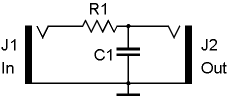
Got a spare A-180 multiple and need a simple slew to round off jaggy gates and S&H signals? Then get out your soldering iron and follow this simple schematic from the Doepfer DIY page.

As you can hear, it's great for removing the clicks you get when feeding a VCA with abruptly changing signals:
(before and after)

Filters also benefit from 'softer' control. I built this as a companion to my Plan B M23 ASR, but you could also feed the quad slew with the outputs of a clock divider like the 4ms RCD and take these outputs directly to your VCA. A cheap and small alternative to tying-up four envelopes!
I used a 4k7 resistor and 1uF capacitor, but you could try other values for a more or less rounded result.
Thanks to fonitronik for the suggested values and help!

As you can hear, it's great for removing the clicks you get when feeding a VCA with abruptly changing signals:
(before and after)

Filters also benefit from 'softer' control. I built this as a companion to my Plan B M23 ASR, but you could also feed the quad slew with the outputs of a clock divider like the 4ms RCD and take these outputs directly to your VCA. A cheap and small alternative to tying-up four envelopes!
I used a 4k7 resistor and 1uF capacitor, but you could try other values for a more or less rounded result.
Thanks to fonitronik for the suggested values and help!
Friday, 2 July 2010
Cwejman RES-4 Demo
Recordings of the quintessential Cwejman module, the Quad VC Resonator.

Download the album for €1 or more to access the audio examples.
For an overview of what the module does, read this Sound On Sound review and for some practical tips on how you might use the RES-4, read this chapter of the classic Synth Secrets series. If the formant techniques described by Gordon Reid sound too much like hard work, you could, of course, just patch a sawtooth into the RES-4, twist the knobs and see what happens.
Listen to the 'Oriental' and 'Formant' examples. The recordings not only show off the sort of vocal effects the RES-4 is capable of, but also the stereo spread caused by the phase cancellations and additions of the four filters when mixing the BP and Notch outputs. 'Voice' and 'Breathing' are similar, using higher Q settings for some resonant phasing. As you can hear, the RES-4 can be used for frequency-dependent panning.
Unlike the MMF-1, the RES-4 needs an input to start oscillating or ringing. A little white noise or short trigger impulse from Maths' EOR does the trick nicely. Listen to the 'Ping' and 'Shiftregister' examples. For me, this is the quad resonator's trademark sound. I know it drives some people nuts, but I love it. Higher Q settings will yield longer rings, using Pressure Points or an analogue shift register allows you to play four-note chords or complex cascades.
Feeding the result into a wavefolder can add bite or bring out steel string-like qualities. Tuning the resonant frequencies and adjusting the gain levels gets you into physical modeling territory. Listen to the 'TWFolded' and 'Logdrums' examples.
'Spacejam' show-cases some of all of the above. It's a single pass, live recording featuring just one VCO, the RES-4 and maybe a touch too much EHX SMMH delay. When the oscillator is slow and the Q high enough, the filter is pinged. At audio rates, the effect is similar to the first couple of recordings.
One last feature that should be mentioned is the amount of voltage control this module offers: frequency and volume on master or individual level, bandwidth per filter. As stretta expertly shows, this allows dynamic and precise settings, although so far, I've been happy enough making manual changes.
I ignored the RES-4 for many years, in part due to its price, but in the time that I've had it has become a firm favourite. The build quality is top notch and the sonic results unique. For more RES-4 examples, listen to the 'dampf', 'nutong' & 'eszieht' tracks from my Synthetic Nature EP or run this search.

Download the album for €1 or more to access the audio examples.
For an overview of what the module does, read this Sound On Sound review and for some practical tips on how you might use the RES-4, read this chapter of the classic Synth Secrets series. If the formant techniques described by Gordon Reid sound too much like hard work, you could, of course, just patch a sawtooth into the RES-4, twist the knobs and see what happens.
Listen to the 'Oriental' and 'Formant' examples. The recordings not only show off the sort of vocal effects the RES-4 is capable of, but also the stereo spread caused by the phase cancellations and additions of the four filters when mixing the BP and Notch outputs. 'Voice' and 'Breathing' are similar, using higher Q settings for some resonant phasing. As you can hear, the RES-4 can be used for frequency-dependent panning.
Unlike the MMF-1, the RES-4 needs an input to start oscillating or ringing. A little white noise or short trigger impulse from Maths' EOR does the trick nicely. Listen to the 'Ping' and 'Shiftregister' examples. For me, this is the quad resonator's trademark sound. I know it drives some people nuts, but I love it. Higher Q settings will yield longer rings, using Pressure Points or an analogue shift register allows you to play four-note chords or complex cascades.
Feeding the result into a wavefolder can add bite or bring out steel string-like qualities. Tuning the resonant frequencies and adjusting the gain levels gets you into physical modeling territory. Listen to the 'TWFolded' and 'Logdrums' examples.
'Spacejam' show-cases some of all of the above. It's a single pass, live recording featuring just one VCO, the RES-4 and maybe a touch too much EHX SMMH delay. When the oscillator is slow and the Q high enough, the filter is pinged. At audio rates, the effect is similar to the first couple of recordings.
One last feature that should be mentioned is the amount of voltage control this module offers: frequency and volume on master or individual level, bandwidth per filter. As stretta expertly shows, this allows dynamic and precise settings, although so far, I've been happy enough making manual changes.
I ignored the RES-4 for many years, in part due to its price, but in the time that I've had it has become a firm favourite. The build quality is top notch and the sonic results unique. For more RES-4 examples, listen to the 'dampf', 'nutong' & 'eszieht' tracks from my Synthetic Nature EP or run this search.
Monday, 28 June 2010
Patch Tips #11 - AC-coupled Mixing
Abusing the Fonitronik Attenuverting Mixer as a fixed-rate slew limiter.

Mixing CVs can yield complex modulations. Fonitronik's mh-01 is perfect for the task and also has a hidden trick up its sleeve. Flicking the mode from DC to AC sends the sum through a capacitor, which leads to a pleasant and unpredictable rounding of the signal.
Two mixed LFOs. Change from DC to AC mode @ 8 seconds.
This is great for cyclical modulations and, while it's less useful for pitch information, can also be used to avoid clicks when feeding a VCA with a S&H signal.

Mixing CVs can yield complex modulations. Fonitronik's mh-01 is perfect for the task and also has a hidden trick up its sleeve. Flicking the mode from DC to AC sends the sum through a capacitor, which leads to a pleasant and unpredictable rounding of the signal.
Two mixed LFOs. Change from DC to AC mode @ 8 seconds.
This is great for cyclical modulations and, while it's less useful for pitch information, can also be used to avoid clicks when feeding a VCA with a S&H signal.
Kids & Modular Synths ...

... they just get it.
Thanks to everyone who came along on Saturday - I hope you had as much fun as I did!
Monday, 21 June 2010
Navs Live + EP Release

Photo © verstaerker
I'll be performing live as part of the Bloom Garden project at the 48 Stunden Neukölln arts festival in Berlin this Saturday (June 26th).
I'll start patching around 16:00 at Parzelle 20 in the 'Hand in Hand' Kleingarten Kolonie in the Rütli Strasse 8, 12045. Same procedure as last year, as they say in Germany!
To accompany the open-air art installation, I've made a collection of recordings, called Synthetic Nature, available for paid download at my new bandcamp page:
I hope you like the sounds enough to buy the EP and, if you can tear yourself away from the football action, look forward to seeing you on Saturday.
Subscribe to:
Posts (Atom)